
· by Michael Blair, Nashville's Cabinets
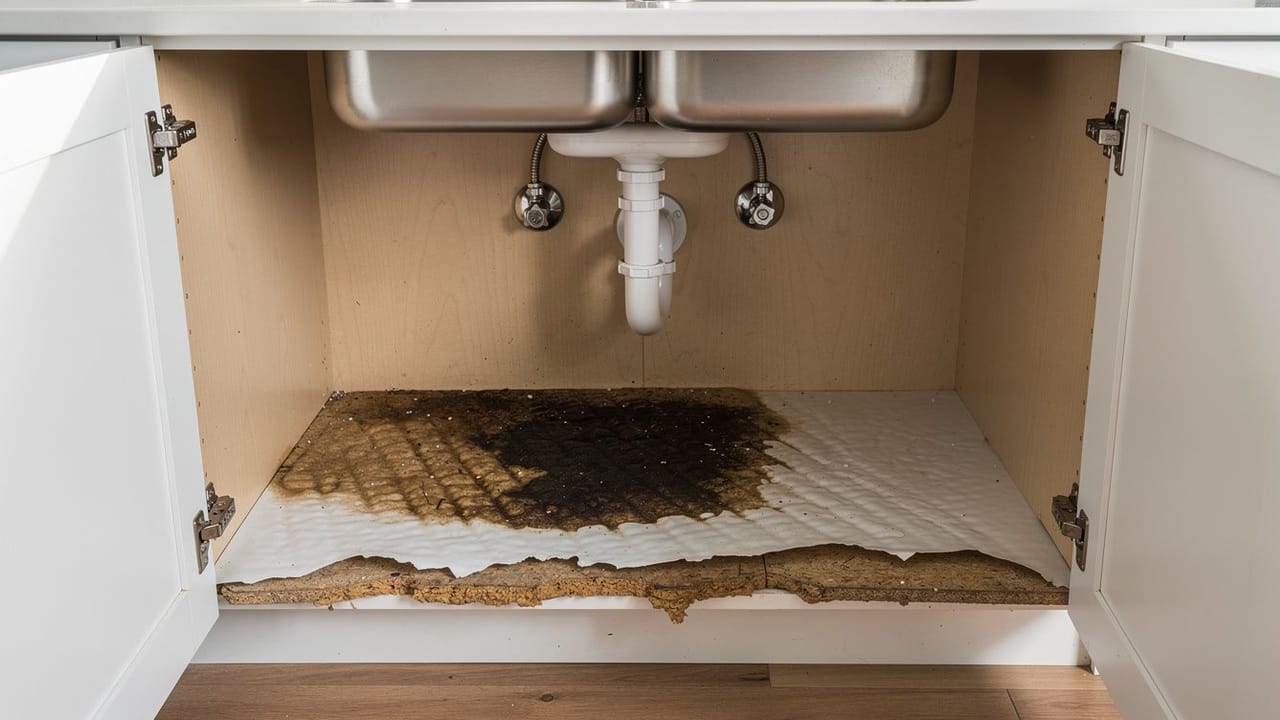
You open the doors under the kitchen sink and the cabinet floor has a hump in it. The front edge is soft, the thin white skin on top has bubbled, and near the bottom the side panels are peeling back from their core. Usually the damage has been building for months, from a drip nobody heard. The questions that follow are always the same: will it flatten out once it dries, is it moldy, and does the whole cabinet have to go. The answers depend on what the box is made of, how long it stayed wet, and whether the leak has actually been stopped.
Why the swelling stays
Most sink bases, including many of the better-built ones, are particleboard or MDF with a melamine or vinyl skin on the faces. The skin sheds a splash. The cut edges, the screw holes and the openings sawn for the drain and supply lines do not, and that is where the water gets into the core. Once it does, the panel thickens and the glue between the wood particles lets go. The Composite Panel Association’s bulletin on dimensional stability says plainly that this swelling is not reversible, and that particleboard and MDF swell more than solid wood does. A panel that has dried out is still thicker and weaker than it was. Drying it with a fan does not bring it back.
Cabinet certification does not change that. The ANSI/KCMA A161.1-2022 cabinet standard tests shelf and bottom loads, door and drawer cycles and how the finish holds up to detergent and spills, but none of its tests sets a cabinet bottom in standing water. The same standard expects a kitchen sink base to have a bottom while it lets the back be left off, which is why the drywall behind the pipes is often bare and gets wet along with the cabinet. A box can carry a certification seal and still swell the same way as any other once a drip has soaked it for a few weeks.
Find the leak before anything is rebuilt
Putting a new floor in a sink cabinet with a leak still dripping onto it just ruins the new floor. In the sink bases we open, the water nearly always comes from a short list of places. The supply lines and the compression nuts at the shutoff valves. The slip nuts on the P-trap. The seals on a garbage disposal. The dishwasher’s drain hose and its supply connection, which run through the side of the sink base. A faucet or sprayer base that lets water run down through the deck. The Insurance Institute for Business & Home Safety’s report on interior water damage describes those flexible supply hoses and their rubber gaskets wearing out from age, pressure, heat, water quality and being knocked around when an appliance is moved, and it puts the average life of a dishwasher at about twelve years.
To find a slow one, empty the cabinet, dry everything with towels, lay dry paper towels on the floor under each joint, then run the faucet, fill and drain the sink and run the dishwasher. The towel that comes back wet sits under the leak. Some damage starts outside the cabinet altogether, from damp dish towels hung over the door. KraftMaid’s care and cleaning guide warns that this moisture can permanently damage the door, and it calls out the areas around the sink and dishwasher for special attention. A failing valve or drain line is a plumber’s job. We schedule the cabinet repair after it is fixed and has stayed dry.
- Supply lines and the nuts at the shutoff valves
- P-trap slip nuts and the drain tailpiece
- Garbage disposal seals and flange
- Dishwasher drain hose and supply line through the side panel
- Faucet or sprayer base leaking down through the sink deck
Mold on a cabinet that stayed wet
The EPA’s guide to mold, moisture and your home says water-damaged materials should be dried within 24 to 48 hours to prevent mold. A slow drip under a sink usually stays wet for weeks before anyone notices it, so we assume there may be growth on the underside of the floor panel, the back of the side panels and the wall behind, even where the top surface looks clean. The EPA’s water damage table treats 48 hours as a guideline rather than a hard line: mold may grow even on material dried sooner, and it will not always grow on material left wet longer.
The same table says drywall can be dried in place if there is no obvious swelling and the seams are intact, and should be removed and replaced if not. Wood surfaces are to be dried right away with dehumidifiers, gentle heat and fans, and finished wood can be cleaned with a mild detergent and clean water. We follow that approach with cabinets. A swollen particleboard floor is not something we try to clean and keep; it comes out. Solid wood face frames and doors that are only stained usually clean up. If growth covers a large area of the wall, or the leak was from a drain rather than clean supply water, we stop and recommend a water damage or mold remediation company before any cabinet goes back in.
A new floor, or a new box that matches
If only the floor panel swelled and the sides, the face frame and the toe kick are solid, the floor alone can be replaced. We cut out the old bottom, check what the sides are fastened to, and fit a new floor on cleats, usually plywood with every edge and pipe hole sealed so the next drip sits on top instead of soaking in. The doors, face frame and countertop stay where they are, and the job is done without matching anything. If the swelling has crept up the sides, the face frame has gone soft at the bottom rail, or the box has dropped enough that the doors have started to sag or rub, the box itself needs replacing.
Replacing a single sink base is easy in a new kitchen and harder in an older one. A stock box from a home center rarely lines up with a twenty-year-old face frame, the door style may be discontinued, and the old finish has aged in a way new paint or stain will not match. What we usually do in older kitchens around Nashville is build one box to the exact width, height and depth of the old one and re-hang the original doors on it, so nothing about the run looks different. The old box can often be taken out in pieces with the countertop left in place. Our cabinet refacing and repair page covers that work, and when the whole run is near the end of its life, a single new box from our custom cabinet shop can be the first piece of a longer plan. A free estimate starts with us looking under the sink.
Sources
- Composite Panel Association, Dimensional Stability of Particleboard and MDF (Technical Bulletin) — Swelling of particleboard and MDF from water is not reversible on re-drying, and is greater than in solid wood.
- ANSI/KCMA A161.1-2022, Performance and Construction Standard for Kitchen and Vanity Cabinets — Sink bases need a bottom but not a back; the standard has no standing-water test of a cabinet bottom.
- IBHS, State of the Risk: Interior Water Damage (2024) — How appliance supply hoses and gaskets fail; average dishwasher life.
- KraftMaid, Care and Cleaning — Moisture from damp towels over a sink base door can permanently damage the door.
- EPA, A Brief Guide to Mold, Moisture and Your Home — Dry water-damaged areas within 24 to 48 hours to prevent mold growth.
- EPA, Water Damage Table (Table 1), Mold Remediation in Schools and Commercial Buildings — The 48-hour mark is a guideline; drywall dried in place only without swelling; wood surfaces dried and cleaned.