
· by Michael Blair, Nashville's Cabinets
Thermofoil doors look like painted cabinets from across the room: a smooth, seamless finish, often white, wrapped around the face and edges of each door in one skin. They hold up well until something hot gets close to them. Then the vinyl starts to bubble, lift at an edge or pull away from the corners, and it almost always starts with the doors nearest the oven. Here is why it happens, why the film rarely stays down once it lets go, and what our crews do with a kitchen whose doors have started to peel.
Why does thermofoil peel?
Thermofoil peels because heat softens the vinyl skin and the adhesive holding it to the board underneath. The skin is a thin film pressed over a shaped MDF core, as our post on cabinet materials in Nashville humidity describes, and the glue that holds it was set with heat in the first place. Holiday Kitchens’ thermofoil care page says plainly that thermofoils can be damaged by excessive heat.
Self-cleaning ovens are the usual source. KraftMaid’s care and cleaning guide says these appliances generate intense heat during a cleaning cycle, and that the oven’s seal or gasket may be damaged during installation or with age, which lets that heat out onto the cabinets beside and above it.
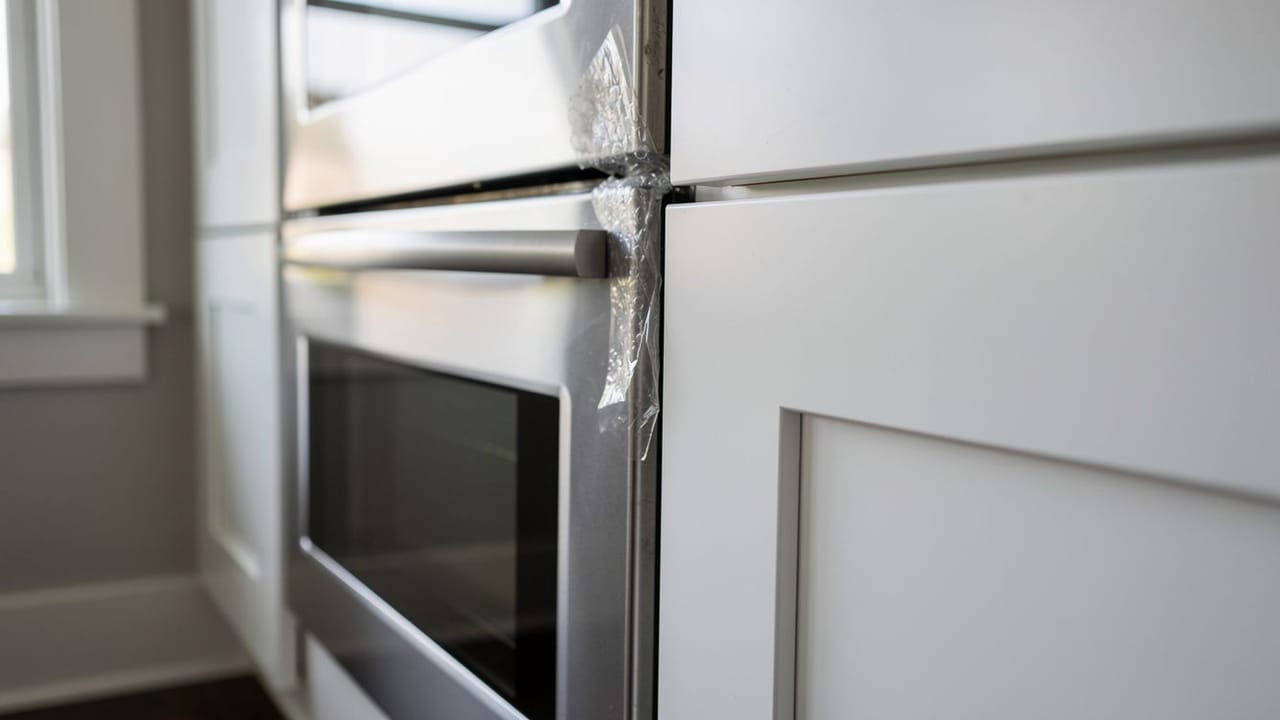
Where the peeling starts tells you what caused it. Holiday Kitchens lists ovens, ranges and dishwashers as the appliances its heat shields protect against, and tells owners to pull toasters, countertop grills and coffee makers out from under the wall cabinets before using them. A door that peels at its bottom edge above a coffee maker is a different story from one that peels down its side beside a wall oven, and the fix has to deal with that source as well as the door.
Can peeling thermofoil be glued back down?
Peeling thermofoil can sometimes be glued back down, but the repair rarely lasts and rarely disappears. Once the film has lifted, it has usually stretched or shrunk, so it no longer fits the profile of the door. Pressed back with contact cement or an iron, it tends to leave a ridge or a wrinkle, and if the heat that caused it is still there, it lifts again.
Paint is not a fix either. Paint sticks only as well as the surface under it, and a vinyl skin that is already letting go from the door will take any paint on top of it with it. We do not paint over peeling thermofoil, and we do not trim the loose film off and paint the bare MDF, which leaves one door that looks and wears differently from the rest.
Our recommendation is usually to replace the damaged doors. A new door is the only result that looks like the ones around it when the kitchen is closed up, and it gives the heat shield something sound to protect.
Can one thermofoil door be replaced to match the rest?
One thermofoil door can be replaced to match when the original maker still offers that door style and color, and the doors around it have not changed color with age. That second condition is the hard part. Wolf’s care and maintenance guide notes that sunlight can fade thermofoil surfaces, and in a kitchen that is ten or fifteen years old, a brand-new white door can sit noticeably whiter than its neighbors.
So we hold a sample door against the old ones in the kitchen’s own light before ordering a set. If it matches, we replace the peeling doors and drawer fronts and leave the rest alone. If it does not, the choice is between replacing every door in the room or refacing the cabinets: new doors and drawer fronts throughout, and the face frames covered to match, while the boxes, the countertop and the plumbing stay where they are. Our post on refacing or replacing cabinets covers when the boxes are worth keeping.
Keeping new doors from peeling beside the oven
New doors last when the heat that ruined the old ones is kept off them. Holiday Kitchens requires heat shields with its foil products and says its lifetime limited warranty is void without them in the necessary locations; it also says heat damage is not covered. Its shields are metal strips 1 9/16 inches wide and 30 inches long, fitted to deflect heat from the cabinets next to an oven, range or dishwasher.
The makers also agree on what to do during a self-cleaning cycle. KraftMaid recommends taking off the doors and drawers next to or directly above the appliance, Holiday Kitchens says to open them away from the oven, and Wolf says the heat of a self-clean cycle is much greater than in normal cooking.
When we replace or reface a kitchen with a thermofoil history, we fit the shields, look at the oven’s gasket, and sometimes suggest a different door material for the cabinets right beside the range. If your doors have started to lift, ask us to look at them, and bring the door style name if you have the original paperwork.
- Heat shields beside the oven, range and dishwasher
- Doors and drawers off or open during a self-clean cycle
- Toasters and coffee makers pulled out from under wall cabinets
- A worn oven gasket replaced
Sources
- Holiday Kitchens, Thermofoil Cabinet Care — Thermofoils can be damaged by excessive heat; heat shields required with foil products, 1 9/16 x 30 inches, for cabinets beside ovens, ranges and dishwashers; warranty void without them; heat damage not covered; open doors during self-clean; pull toasters and coffee makers out from under cabinets
- KraftMaid Cabinetry, Care and Cleaning — Self-cleaning appliances generate intense heat; oven seal may be compromised in installation or with age; remove doors and drawers adjacent to or above the appliance during a cleaning cycle
- Wolf Home Products, Signature Series Care and Maintenance Guide — Self-clean heat far greater than normal cooking; remove nearest doors and drawers before self-cleaning; sunlight can fade thermofoil surfaces
FAQ
Peeling Thermofoil Cabinet Doors: Fix or Replace — questions
Can you paint thermofoil cabinets that are peeling?
Not with lasting results. Paint is only as secure as the surface under it, and a vinyl skin that is already letting go will lift the paint with it. Peeling doors are replaced, or the kitchen is refaced, rather than painted over.
Does a heat shield stop thermofoil from peeling?
It protects the cabinets beside an oven, range or dishwasher by deflecting heat away from them. Holiday Kitchens requires its shields with foil doors and voids its warranty without them. It does not protect doors above a toaster or coffee maker, which should be pulled out from under the cabinets when used.
Why is thermofoil peeling above my dishwasher?
Heat and moisture from the dishwasher reach the cabinets around it. Holiday Kitchens lists dishwashers with ovens and ranges as the appliances its heat shields guard against. So a door that peels beside the dishwasher calls for a shield on that side as well as a new door.
Is heat damage to thermofoil covered by the warranty?
Often not. Holiday Kitchens says heat damage is not covered and that its lifetime limited warranty is void if heat shields were not installed where needed. Other makers word it differently, so read the warranty for your cabinet line before assuming either way.
Can thermofoil doors be replaced without replacing the cabinets?
Yes. Doors and drawer fronts can be replaced on their own when the maker still offers a match, or the whole kitchen can be refaced with new doors and covered face frames. The cabinet boxes, countertop and plumbing stay in place either way.