
· by Michael Blair, Nashville's Cabinets
Most people searching for cabinet refinishing want to know what it costs and how long the kitchen will be out of use. In an older house there is a question that comes before either one: what is under the paint that is already there. Refinishing means taking the existing finish down far enough for a new coat to bond, and when the cabinets have been painted more than once since the house was built, some of those lower layers may contain lead. If the home was built before 1978, a federal rule governs how a paid crew is allowed to do that step. It shapes the prep, the tools on the job and how the room is cleaned afterward, and it is worth understanding before you hire anyone for cabinet refinishing and painting.
Why the build year matters for a cabinet job
The cutoff comes from the EPA. Its Renovation, Repair and Painting Program applies to homes, childcare facilities and preschools built before 1978, and it requires anyone paid to do work that disturbs painted surfaces in those buildings to be certified and to use trained workers. The EPA is clear that the requirement reaches every firm, sole proprietors included, so a one-person painting outfit is covered the same as a large company.
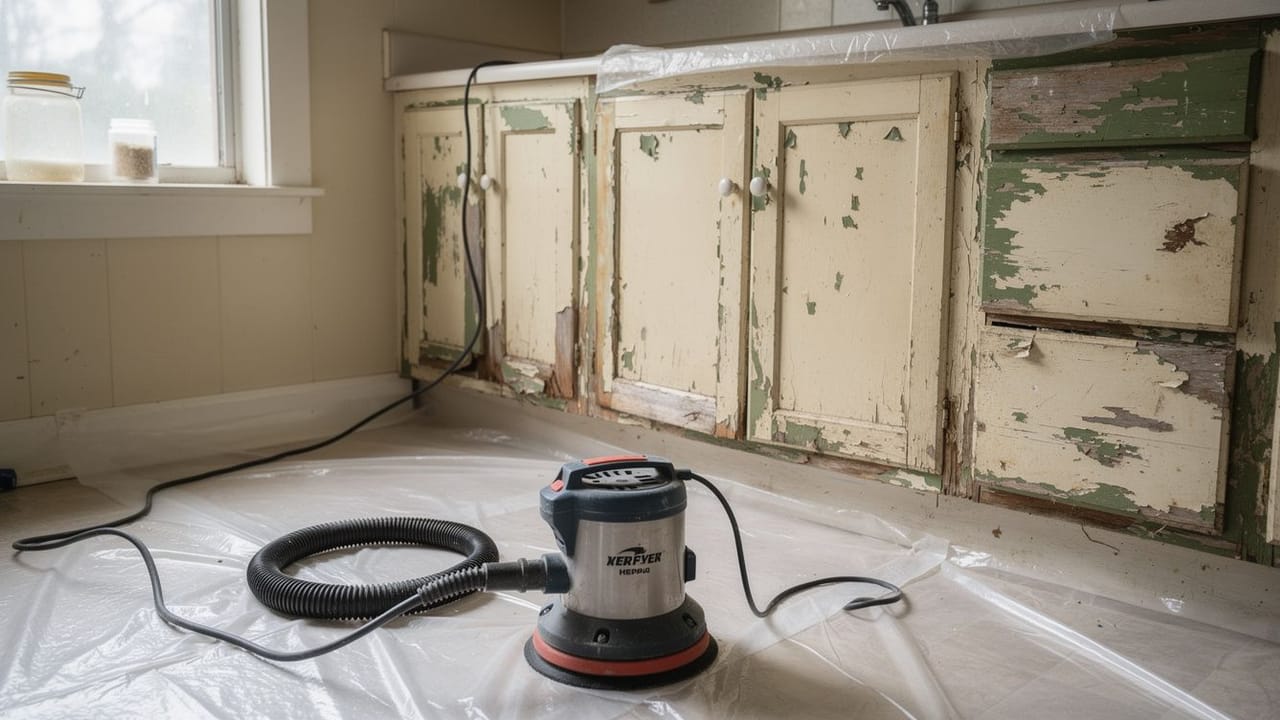
Cabinets are easy to overlook here because they feel like furniture rather than part of the house. But the boxes, face frames and doors in an older kitchen have often been painted along with the trim, sometimes by the original builder and again by each owner after that. A set of oak cabinets that were stained and never painted is a different starting point from a run of painted pine doors in a house that has changed hands four times. Many of the established neighborhoods around Nashville and the older streets near downtown Franklin have kitchens like the second kind, which is why the build year is one of the first things we ask about when we look at a refinishing job.
What the rule says about sanding and stripping
The part of the regulation that matters most for cabinets is the list of restricted work practices in 40 CFR 745.85. It prohibits open-flame burning or torching of painted surfaces outright. It allows a heat gun only below 1,100 degrees Fahrenheit. And it bars high-speed removal tools on painted surfaces, including power sanders, grinders, power planers and abrasive blasting, unless the tool has a shroud or containment and a HEPA vacuum attachment pulling the dust off at the point where it is made, with no visible dust escaping the shroud.
That last restriction is the one that changes a cabinet job. An ordinary orbital sander run across a painted door throws fine dust into the air, onto the counters and into the open boxes. Under the rule, sanding painted cabinets in a covered home has to be done with shrouded sanders tied to a HEPA vacuum, by hand with methods that keep dust down, or not at all. A refinisher who plans to scuff everything with an open sander and sweep up afterward is describing a method the regulation does not allow on a regulated surface.
- No torch or open flame on painted cabinets
- Heat guns only below 1,100°F
- Power sanding only with a shroud and a HEPA vacuum attachment
- No visible dust escaping the tool
Small repairs, test kits and your own kitchen
The rule has a narrow exception for minor work. Under the definitions in 40 CFR 745.83, minor repair and maintenance means disturbing six square feet or less of painted surface per room on interior work, without using any of the prohibited or restricted practices above. Jobs in the same room within 30 days count as one job. Touching up a chipped corner on one door can fit inside that. Refinishing a kitchen does not: the fronts and backs of every door, the drawer faces and the face frames add up to far more than six square feet, so the full requirements apply.
Testing can take a job out of the rule. The EPA says an EPA-recognized test kit, used by a trained professional, can show that regulated lead-based paint is not present when the result is negative. On cabinets, the test belongs on the surfaces that will actually be sanded or stripped, not on one convenient spot. If the results come back negative, the cabinets can be prepped the usual way. If they come back positive, or nobody tests, the work proceeds as if lead is there.
Homeowners working on their own house are treated differently. The same EPA page says the rule does not apply to a homeowner doing the work in a pre-1978 home they live in, unless they rent out part of it, run a childcare there, or are fixing it up to sell for profit. That is an exemption from certification, not a statement that the dust is harmless, and the same sanding that would be restricted for a paid crew puts the same dust into a kitchen when an owner does it.
What to ask a refinisher in Tennessee
Tennessee does not run its own version of this program. The state’s TDEC lead-based paint regulatory matrix says the EPA has jurisdiction to implement and enforce the renovation rule here, and that EPA certification as a renovation firm and as a renovator is required in Tennessee. The state handles lead abatement, which is a separate activity with its own rules. For a refinishing job, the certification that matters is the EPA one.
So the questions are straightforward. Know when the house was built. Ask whether the cabinets will be tested and what with. Ask to see the firm’s EPA certification and the name of the certified renovator who will be responsible on the job. Ask how the doors will be sanded, what the dust collection is, and how the kitchen will be sealed off and cleaned before you move back into it. A refinisher who answers those clearly is planning around the rule; one who has not thought about them is planning around the clock.
None of this decides the finish itself, which is its own choice and is covered in our post on whether painted or stained cabinets last longer. It decides how the old surface comes off before the new one goes on. If your kitchen is in an older house and you want the cabinets looked at, ask for a free estimate and tell us the year the house was built when you do.
Sources
- EPA, Lead Renovation, Repair and Painting Program — Covers pre-1978 homes, childcare facilities and preschools; paid firms must be certified, sole proprietors included; homeowner exemption and its limits; negative EPA-recognized test kit results.
- eCFR, 40 CFR 745.85, Work Practice Standards — Open-flame burning prohibited; heat guns below 1,100°F; high-speed removal only with shroud and HEPA attachment.
- eCFR, 40 CFR 745.83, Definitions — Minor repair and maintenance: six square feet or less per room interior, no restricted practices; jobs in the same room within 30 days count as one.
- Tennessee Department of Environment and Conservation, Lead-Based Paint Abatement and RRP Regulatory Requirements Matrix — EPA implements and enforces the renovation rule in Tennessee; EPA firm and renovator certification required.