
· by Michael Blair, Nashville's Cabinets
Two kitchens with identical doors can feel completely different, and most of that difference is in the hinges and drawer runners. They are also the parts that give out: the Kitchen Cabinet Manufacturers Association’s explainer on its A161.1 testing says drawer glides and hinges frequently fail in uncertified cabinets after just one year of use. KCMA runs that certification, so it has a stake in saying so, but it is a fair reason to ask about hardware before you sign anything.
Why choose full-extension drawer runners?
Full-extension runners let the drawer come all the way out, so the back is usable. Partial extension leaves part of the drawer inside the cabinet, and in a deep drawer that is where things get forgotten. Blum sells its TANDEM concealed runners in both full and partial extension, which is why it pays to ask which one a quote actually includes.
Concealed runners stay out of sight, and Blum’s runner systems overview lists MOVENTO and both of its TANDEM lines as concealed systems, in standard and heavy-duty versions. Soft-close is widely available now, and on TANDEM it is built into the runner itself. We think it is worth insisting on.
Why do concealed hinges matter?
Concealed European hinges adjust, so a door can be lined up properly when it is hung and realigned later as the house moves. Blum’s CLIP top hinge page says all of its hinges adjust for side, depth and height; when a quote says six-way adjustment, it is counting both directions on each of those three. Soft-close comes either built into the hinge, as on Blum’s CLIP top BLUMOTION, which carries the mechanism in the hinge cup, or as a separate damper.
Hinges with limited adjustment make alignment harder, so when the doors in a kitchen will not line up, the hinges are the first thing we look at. Our post on cabinet doors that sag, rub or will not close goes through the other causes.
- Full-extension concealed drawer runners
- Soft-close on both doors and drawers
- Concealed hinges with side, depth and height adjustment
- Dovetailed or well-made drawer boxes, not stapled
- A load rating on the runners for pan drawers
Drawer boxes
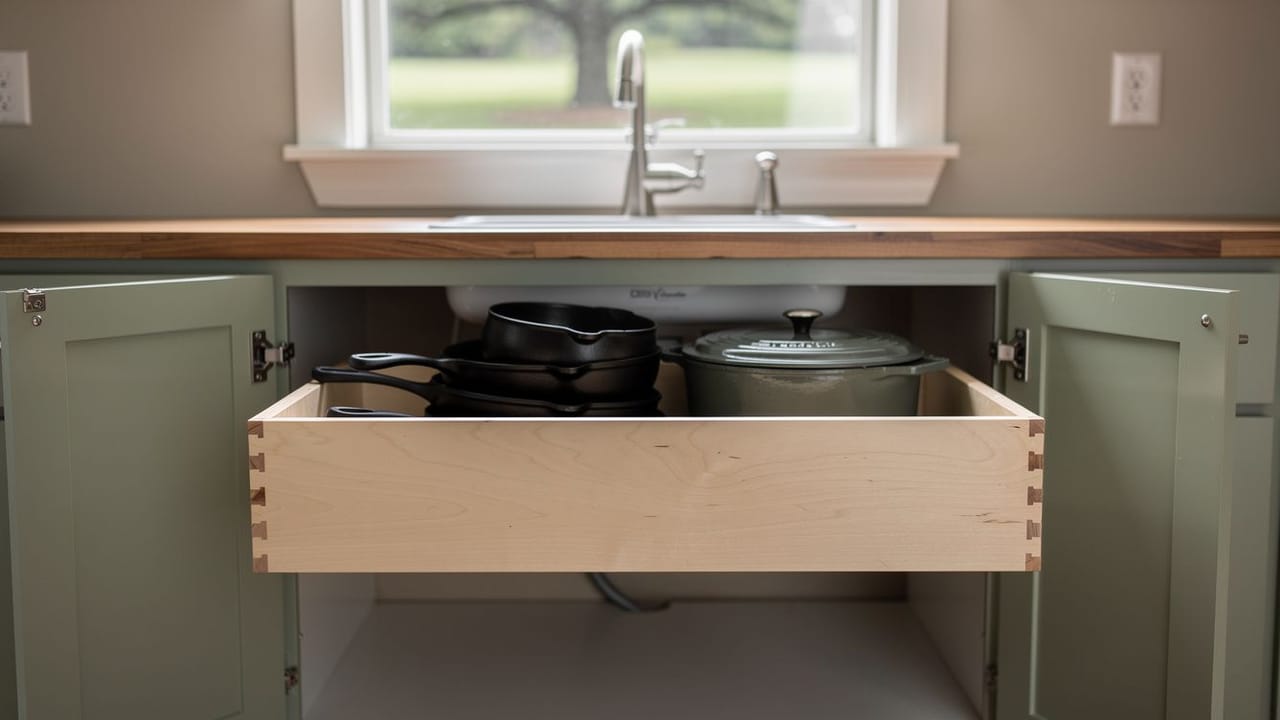
In our experience the box matters as much as the runner. Dovetailed solid wood or good plywood boxes hold up under a drawer full of pans, and stapled particleboard is what we tend to find coming apart.
Runner ratings vary a lot. Blum rates TANDEM for up to 100 pounds per drawer and its heavy-duty MOVENTO at 170 pounds, so if deep drawers will hold dishes, cast iron or a stand mixer, check the rating against what will really go in them. Cabinets with KCMA’s quality certification have been through testing meant to stand in for a lifetime of use; part of it, by the association’s own account, is 25,000 loaded cycles of opening and closing the doors and drawers.
Upgrading existing cabinetry
Soft-close can often be added to the hinges you already have. Blum makes a clip-on BLUMOTION damper that clips onto the hinge and a retrofit version that attaches to the cabinet instead; whichever you buy, check that it is made for your hinge brand and model. Converting side-mount drawers to concealed runners is a bigger job, and on an older kitchen we look hard at whether it is worth it.
New handles and knobs change the look of a kitchen without any carpentry, and they are a sensible place to start when the boxes and hinges are still good. Soft-close, pull-outs and organizers fitted into cabinets you are keeping are what our hardware and storage work covers, and when you want a second opinion on the hinges and runners in your own kitchen, ask us for a free estimate.
Sources
- KCMA, ROI of Durable Cabinets / ANSI/KCMA A161.1 — Drawer glides and hinges frequently fail in uncertified cabinets after one year; doors and drawers cycled 25,000 times under load
- KCMA, KCMA Quality Cabinet Certification — Certified cabinets have structure, drawers, doors and finish tested to simulate a lifetime of use
- Blum, TANDEM runner system — Full or partial extension; integrated BLUMOTION soft-close; up to 100 lbs per drawer
- Blum, Runner systems overview — MOVENTO and TANDEM lines are concealed runner systems in standard and heavy-duty options
- Blum, MOVENTO runner system — Heavy-duty MOVENTO has a 170-pound load rating
- Blum, CLIP top hinge (US) — All Blum hinges adjust for side, depth and height
- Blum, CLIP top BLUMOTION hinge — Soft-close mechanism integrated in the hinge cup
- Blum, CLIP top hinge (UK page) — Clip-on BLUMOTION clips onto the hinge; retrofit BLUMOTION attaches to the cabinet
FAQ
The Cabinet Hardware Worth Paying For — questions
Is soft-close hardware worth it?
You notice it every time a door or drawer shuts, and it is widely available on new cabinetry, built into the hinge or the runner on lines like Blum’s. If a quote leaves it out, ask what the runners and hinges are rated for and whether the cabinets are tested, since KCMA says glides and hinges are the parts that often fail in uncertified cabinets.
What is the difference between full and three-quarter extension?
A full-extension runner lets the whole drawer clear the cabinet, back included. Three-quarter extension is a partial-extension runner, so part of the drawer stays inside the cabinet, where things get lost. On deep drawers the difference is easy to feel, so check which kind a quote specifies.
Can I add soft-close to my existing cabinets?
Often, on the doors. Clip-on dampers attach to concealed hinges, but each is made for particular hinges, so check that the damper matches your hinge brand and model. Drawers are harder: on runners like Blum’s TANDEM and MOVENTO the soft-close is built into the runner, so adding it means replacing the runners, and that is only sensible when the drawer boxes are in good shape.
Can you adjust soft-close cabinet hinges?
Yes. Concealed hinges, soft-close ones included, adjust for side, depth and height, which Blum says is true of every hinge it makes, so a door can be lined up when it is hung and again as the house moves. On Blum’s CLIP top BLUMOTION, the soft-close mechanism is built into the hinge cup rather than added as a separate damper.