
· by Michael Blair, Nashville's Cabinets
The three tiers are often presented as a quality ladder. They are really a flexibility ladder, and quality varies within each. The Kitchen Cabinet Manufacturers Association, which certifies cabinets to its A161.1 standard, says its certified cabinets are sold at every price point, from builder-grade to high-end custom. What you are buying at the top is dimensional freedom.
What are stock cabinets?
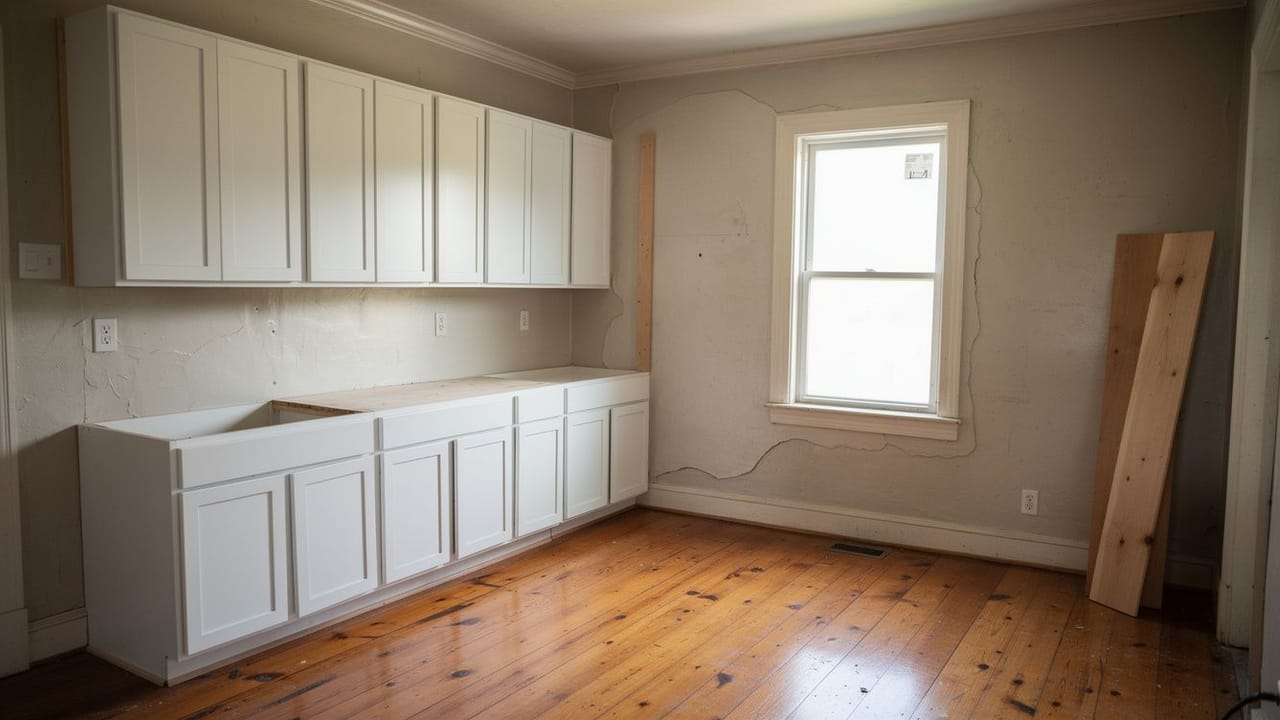
Fixed sizes in set increments, and price and speed are why people choose it. Where the boxes stop short of a wall, the gap is closed with a filler panel. In a square room a narrow filler disappears; against an out-of-plumb wall in an older Nashville house it has to be scribed to the wall, and a wide one shows.
Quality ranges from poor to genuinely good, so judge the box and hardware rather than the category. A quick check is the KCMA A161.1 seal: according to the association’s certification page, certified cabinets have passed 14 tests, a 600-pound load test among them, covering structural strength, drawers and doors, and finish durability, and between 40 and 50 percent of cabinets fail their first attempt.
What are semi-custom cabinets?
Stock sizes with modifications — depth changes, height changes, finish and door style choices. It often suits a kitchen that is close to standard with a few awkward spots, such as a deeper upper over the refrigerator or a run that has to be taller to meet the ceiling. What we fit in this range is on our semi-custom and stock cabinets page.
Ask for the lead time in writing before you order, and plan the job around that date rather than a figure from someone else’s kitchen. Our post on what cabinet lead times do to a schedule walks through everything that waits on it.
What are custom cabinets?
Built to your dimensions, in any configuration and material. That is what our custom cabinetry is for: period houses with unusual ceiling heights, awkward walls, and anywhere a run has to be exact.
It usually costs more and takes longer than either other tier, and the shop that builds it matters more. Whoever builds it, if the boxes are particleboard, MDF or hardwood plywood, ask to see that the panels are labeled TSCA Title VI compliant; the EPA’s page on formaldehyde standards for composite wood says those products, and finished goods containing them, have had to carry that label since March 2019.
- Square modern room, tight budget: stock
- Close to standard, a few odd dimensions: semi-custom
- Older house, irregular walls, unusual ceiling height: custom
- Within any tier: judge the box and hardware, and look for the KCMA seal
Where Nashville houses push toward custom
The Metropolitan Historical Commission’s guides to Nashville’s turn-of-the-century houses and its revival-style houses of 1900 to 1945 both say kitchens and bathrooms usually need a complete overhaul, and both discourage lowered ceilings as a change that is hard to reverse. So in those houses the cabinets are fitted to the ceiling the room already has. We measure every wall at more than one height before recommending a tier, because we cannot assume the corners or the ceiling match what standard boxes expect.
Semi-custom with modified heights handles a lot of it; genuinely irregular rooms need custom. Where standard boxes would leave wide fillers or an empty band above the uppers, that is our cue to move up a tier. If you are not sure which side of that line your kitchen falls on, book a free estimate and we will measure before anything is ordered.
Sources
- Kitchen Cabinet Manufacturers Association, KCMA Cabinet Certifications — A161.1 seal; certified cabinets at every price point; 14 tests including a 600-pound load test; 40 to 50 percent fail the first attempt
- U.S. EPA, Formaldehyde Emission Standards for Composite Wood Products — Hardwood plywood, MDF, particleboard and finished goods containing them must be labeled TSCA Title VI compliant after March 22, 2019
- Metropolitan Historical Commission, Nashville Old House Series: The Neoclassical Revival — Turn-of-the-century houses: kitchens and bathrooms usually require a complete overhaul; lowered ceilings discouraged as hard to reverse
- Metropolitan Historical Commission, Nashville Old House Series: The Revival Styles 1900-1945 — Revival-style houses: kitchens and bathrooms usually require a complete overhaul; lowered ceilings discouraged as hard to reverse
FAQ
Stock, Semi-Custom or Custom Cabinets — questions
Are custom cabinets better quality than stock?
Not automatically. The Kitchen Cabinet Manufacturers Association says its certified cabinets are sold at every price point, from builder-grade to high-end custom, so the tier alone tells you little about how a cabinet is built. Look at the box material, how it is joined and the hardware. What custom reliably buys is dimensional freedom — cabinetry built to your room rather than your room adapted to standard sizes.
What are lead times like?
They vary by tier and by manufacturer. Stock is generally the quickest and custom the slowest, but the only figure worth planning around is the one the supplier gives you in writing. We have the cabinets ordered and the delivery date confirmed before demolition starts, because everything after them in a kitchen waits on them.
Do I need custom for an older Nashville house?
Not always. Semi-custom with modified heights and depths handles many older kitchens once the walls have been measured. Genuinely irregular rooms, unusual ceiling heights or a run that has to be exact wall to wall are where custom earns its cost.
Are custom cabinets more expensive than stock?
Usually, and they take longer too. Stock is chosen for price and speed, with filler panels closing the gaps between its fixed sizes, and semi-custom sits between the two. A higher price does not guarantee a better cabinet, since KCMA-certified cabinets are sold at every price point. What custom buys is a box built to the room’s exact dimensions.